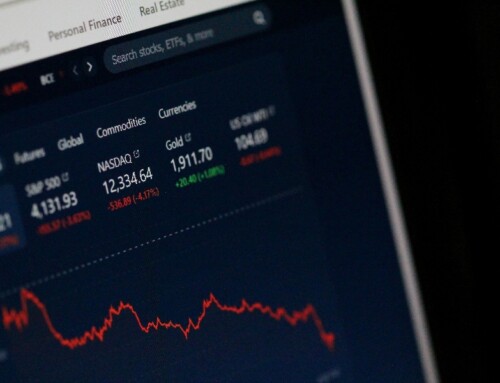
In one trading session, the Japanese yen did something that currencies of large developed economies rarely do: it moved several per cent against the US dollar. The dollar had traded near ¥164 late last week. After Japan and the United States confirmed coordinated intervention, it fell as low as about ¥155.20 before settling nearer ¥156. That is a very large change for the world’s third-most-traded currency pair.
The Associated Press reported that the Japanese side spent more than ¥8 trillion, over US$50 billion, to support the yen. Japan’s finance ministry said it had purchased yen in coordination with the US Treasury and would not hesitate to act again if necessary.
The first market reaction was visible in Japan. The Nikkei 225 fell 1.1 per cent on Monday. But the more important question is not what happened to Japanese shares in one day. It is whether repeated action to strengthen the yen can change the price of money around the world.
I believe the answer is yes. The direction you are thinking about, higher US yields, tighter credit and pressure on expensive equities and mortgages, is plausible. The sequence, however, is conditional. We need to separate a one-off currency operation from a durable change in where Japanese institutions choose to invest trillions of dollars.
First, who is actually buying the yen?
The Bank of Japan is responsible for monetary policy. Japan’s Ministry of Finance is responsible for deciding whether to intervene in the foreign-exchange market. The Bank of Japan may execute the trade as the ministry’s agent, but the policy decision and the financing sit with the ministry.
This matters because currency intervention and an interest-rate increase are different tools. To strengthen the yen directly, Japan sells foreign currency assets or uses foreign-currency liquidity and buys yen. To strengthen the yen through monetary policy, the Bank of Japan can raise Japanese interest rates or allow domestic bond yields to rise, making yen assets more attractive.
On 31 July, the Bank of Japan kept its overnight policy-rate target at around 1.0 per cent. The vote was 8–1, with one member preferring 1.25 per cent. In other words, the dramatic currency move came from intervention and coordination, not from a surprise Bank of Japan rate increase.
That also explains why the present move is unusual. The US and Japanese finance ministers’ joint framework says foreign-exchange intervention should be reserved for excessive volatility or disorderly movements, and should be disclosed transparently. The United States participating alongside Japan sends a much stronger signal than Japan acting alone.
The first route to US yields: official dollar assets
When Japan buys yen, it must deliver dollars or other foreign currency on the other side of the trade. Those dollars can come from cash deposits, Treasury bills, longer-dated securities, short-term financing or other reserve assets. Therefore, a US$50 billion intervention does not automatically mean Japan sold US$50 billion of 10-year Treasury notes that same day.
But if intervention is repeated, the funding question becomes more important. Japan’s official reserves are large, and US government securities are a natural part of that pool. Using more of those dollar resources can mean selling Treasury securities, allowing bills to mature without reinvesting, or reducing future purchases. Each route removes some demand from the US bond market.
Bond prices and yields move in opposite directions. If a major buyer sells bonds or buys fewer new bonds, another investor must absorb the supply. The clearing price may need to fall, which means the yield rises. The effect is especially relevant when the US government is already issuing a great deal of debt and long-term rates are sensitive to the term premium investors demand for holding it.
The scale of Japanese ownership is not trivial. A US Treasury survey measured Japanese investors’ US securities at US$2.883 trillion in June 2025, including US$1.169 trillion of Treasuries, US$1.024 trillion of US equities and US$250 billion of corporate debt. Those figures combine official and private holdings, but they show why a change in Japan’s behaviour matters globally.
Historical Federal Reserve research gives a sense of the mechanism, not a forecast for today. A 2012 Federal Reserve paper estimated that a US$100 billion monthly drop in foreign official Treasury inflows could lift five-year yields by roughly 40 to 60 basis points in the short run. After private investors responded to the higher yield, the estimated long-run effect was around 20 basis points.
We should not apply those numbers mechanically. The study used an earlier market, different fiscal conditions and a broad foreign-official shock, not Japanese intervention alone. Its useful lesson is that replacement buyers eventually appear, but usually only at a price.
The bigger route may be private Japanese money
Official intervention gets the headlines. Private portfolios may have the larger and more persistent effect. Japan is one of the world’s largest net creditors. The International Monetary Fund estimated Japan’s net foreign assets at about US$3.7 trillion in the third quarter of 2025. Banks, insurers, pension funds and households have accumulated foreign bonds and shares because overseas yields were much higher than those available at home.
A stronger yen changes that calculation in two ways. First, an unhedged US investment loses value when translated back into yen. A US bond can pay its coupon and still produce a poor yen return if the dollar falls enough. Second, if Japanese government bond yields rise, domestic assets become more competitive. An investor no longer needs to travel as far abroad for income.
The IMF has warned that rising Japanese government bond yields could encourage a gradual reallocation toward domestic bonds. It noted that Japanese investors are among the largest holders of US Treasuries and euro-area sovereign debt, so repatriation could increase issuance costs abroad. The same report also cautioned that the largest Japanese institutions tend to change mandates gradually, not all at once.
This is why a durable Bank of Japan policy shift would matter more than a single day of intervention. If Japan repeatedly buys yen while Japanese rates and bond yields remain low, global investors may eventually test the authorities again. If intervention is followed by higher Japanese yields, the relative return on US assets changes and private repatriation becomes more likely.
The carry trade can turn a currency move into forced selling
For years, the yen has also served as a cheap funding currency. An investor could borrow yen at a low rate, convert the proceeds into dollars and buy a higher-yielding bond or a riskier asset. The return depended on the yield difference and on the yen not strengthening too much.
When the yen jumps, the liability becomes more expensive in dollar terms. A leveraged investor may receive a margin call or choose to close the trade. Closing it means selling the asset that was purchased, perhaps a Treasury, corporate bond, emerging-market security or equity, and buying yen to repay the loan. The buying of yen then strengthens it further.
This feedback loop is why a currency move can produce outsized volatility. It is similar to a property investor who used a cheap floating-rate loan to buy a higher-yielding asset. The investment may look comfortable while financing and exchange rates remain stable. If both move against the investor, the asset may have to be sold for liquidity rather than because its long-term value disappeared.
Why the US Treasury yield may rise, and why it may not
The defensible conclusion is that persistent yen strengthening could make Federal Reserve rate cuts less likely and, under an inflationary scenario, contribute to the case for higher rates. It would not independently force a rate increase. The Federal Reserve does not target a particular level for the dollar; it considers how exchange-rate movements affect US inflation, employment and economic activity.
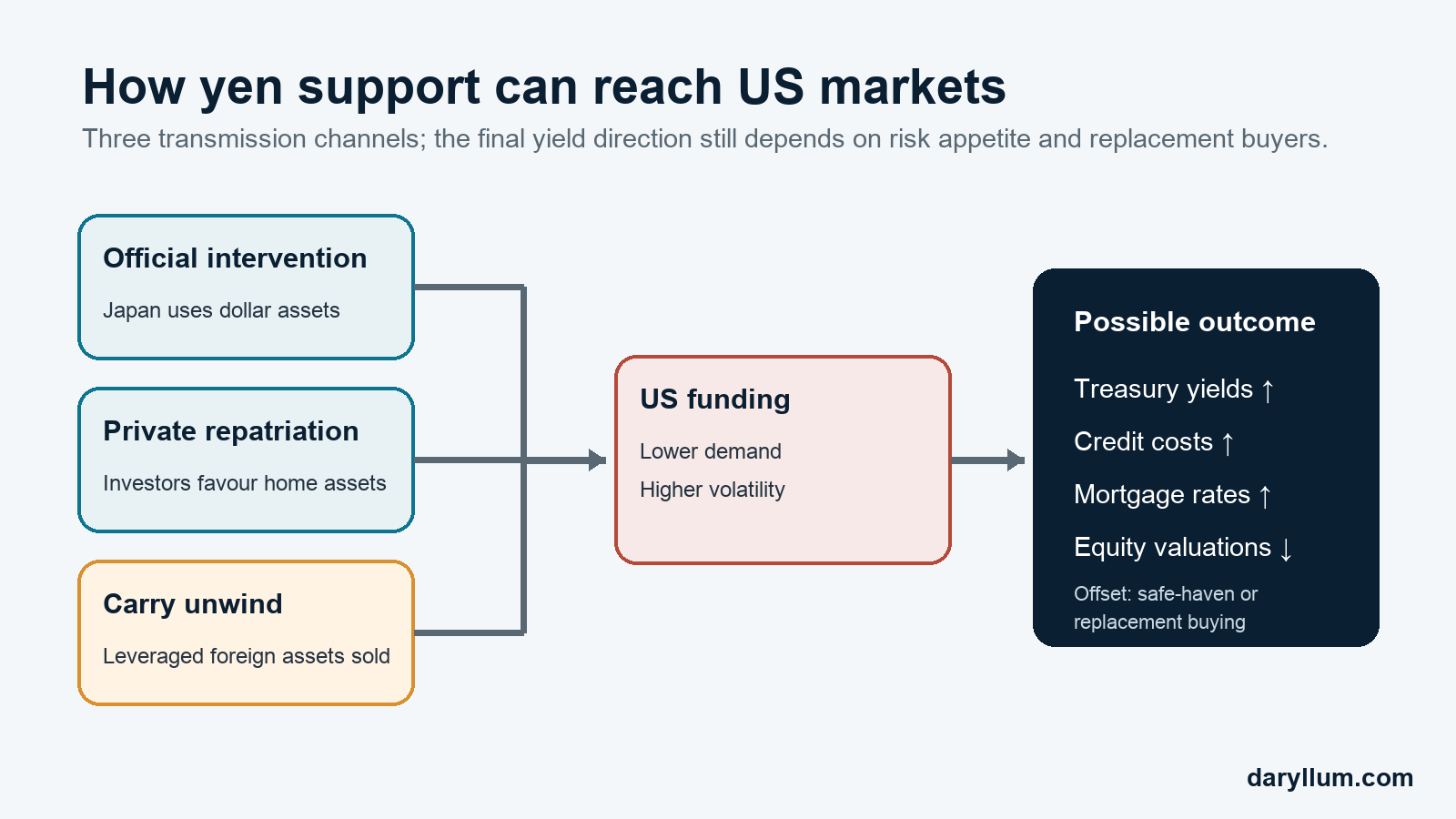
There are three reasons for an upward move in yields: Japan may use or stop reinvesting official dollar assets; private Japanese institutions may bring capital home; and carry-trade positions may be unwound. All three reduce demand or create selling pressure in US fixed income.
The starting point is already demanding. The US Treasury’s official curve put the 10-year yield at 4.75 per cent and the 30-year yield at 5.28 per cent on 31 July. Less foreign demand at those levels could push the term premium higher.
But the yield direction is not guaranteed. A violent carry-trade unwind can also create a global risk-off event. Investors may sell equities and corporate bonds while buying Treasuries for safety, pushing Treasury yields down. Other private buyers may also step in when yields rise. Federal Reserve rate expectations, inflation, oil and US fiscal policy may overwhelm the currency channel.
This apparent contradiction is common in markets. Treasuries can be the asset being sold to raise cash at the start of a shock and the safe haven being bought once fear takes over. The timing and the part of the yield curve therefore matter as much as the final direction.
How higher yields reach the US credit market
A company’s borrowing cost is broadly the government-bond yield plus a credit spread. The Treasury yield is the base rate. The spread compensates investors for default risk, liquidity and uncertainty.
If Japan-related selling lifts Treasury yields while markets remain calm, the base rate rises. New corporate bonds, bank loans and refinancing become more expensive. If the yen move also causes risk aversion, credit spreads can widen at the same time. That is the uncomfortable double hit: a higher benchmark and a larger risk premium.
The most exposed businesses are not necessarily those with the weakest current earnings. They are the companies that must refinance soon, rely on floating-rate debt, have thin interest coverage or need constant access to capital. Highly leveraged acquisitions, commercial real estate, lower-rated issuers and companies funding large projects before they generate cash flow deserve particular attention.
Credit tightening can also reach the economy before defaults rise. Banks may reduce loan growth, bond investors may demand stronger covenants and new issues may be postponed. Investment slows, hiring becomes more cautious and weaker borrowers lose flexibility.
Mortgages do not sit outside the bond market
US fixed mortgage rates are closely connected to longer-term Treasury yields and mortgage-backed securities. A lender that fixes a rate for 30 years must price the risk that market rates, prepayments and funding costs will change.
Federal Reserve research on foreign capital flows found that strong foreign demand for Treasuries and agency securities helped lower yields not only on safe government assets but also on mortgages and corporate bonds. The reverse channel is straightforward: if foreign demand retreats and long-term yields rise, mortgage rates generally face upward pressure.
The mortgage rate does not move point-for-point with the 10-year Treasury. Its spread can widen when bond volatility increases because homeowners have the option to refinance when rates fall but can keep the loan when rates rise. Greater uncertainty makes that option more expensive to investors. So a yen-driven bond-market shock could lift the Treasury benchmark and the mortgage spread together.
Higher mortgage rates reduce affordability even if home prices do not change. They can slow transactions, discourage refinancing and leave existing owners locked into older low-rate loans. Residential construction and mortgage-related consumption may then weaken.
What it means for the US stock market
Expensive growth shares
Higher long-term yields reduce the present value of profits expected far into the future. This tends to hurt companies trading at high valuations, especially where today’s cash flow is small relative to what investors expect many years from now. Artificial-intelligence and other long-duration growth themes can therefore be sensitive even when their business outlook has not changed overnight.
Leveraged and refinancing-dependent companies
Higher interest expense reduces profit and cash available for dividends, buybacks and investment. The equity of a heavily indebted company absorbs the effect after bondholders and lenders have been paid, so relatively small changes in enterprise value can create larger changes in the share price.
Banks and insurers
Financial companies are mixed. A steeper yield curve can improve lending margins, but sharp bond losses, wider credit spreads and weaker borrowers can damage capital and asset quality. The speed of the move is often more important than the level.
Japanese exporters and US multinationals
A stronger yen reduces the yen value of profits earned overseas by Japanese exporters and makes Japanese products more expensive abroad. US exporters can become more competitive in Japan. For a US multinational, yen revenue converts into more dollars, although the benefit depends on hedging and local costs.
The broad index
If Treasury yields rise without a recession scare, valuation pressure may dominate. If intervention triggers a disorderly deleveraging event, equities and credit may fall together while high-quality Treasuries later rally. The same yen move can therefore produce different bond-equity correlations at different stages.
Four scenarios worth distinguishing
1. A successful one-off signal
US-Japan coordination convinces traders not to push the yen weaker. Intervention stops, Japanese rates are unchanged and private portfolios do not materially move. The effect on US yields is likely modest and temporary.
2. Repeated intervention funded from reserves
Japan must repeatedly deliver dollars. Treasury bills mature without reinvestment or securities are sold. US yields and bond volatility face upward pressure, although replacement buyers limit the eventual move.
3. A durable Japanese rate and repatriation shift
The Bank of Japan raises rates or Japanese government bond yields stay high while the yen strengthens. Japanese institutions find domestic bonds more attractive and reduce foreign allocations over time. This is the scenario with the largest persistent effect on global bond yields, credit costs and equity valuations.
4. A disorderly risk-off unwind
Leveraged carry trades close quickly. Risk assets and corporate credit fall, market liquidity worsens and Treasuries are initially sold for cash. If recession fears take over, safe-haven demand and expectations of easier Federal Reserve policy may later pull Treasury yields down.
What I would watch next
- Whether the dollar stays below the former intervention zone or climbs back toward ¥160–¥164.
- Japan’s monthly intervention disclosures and whether reserve composition changes.
- The Bank of Japan’s policy rate and Japanese government bond yields, not just official comments about the currency.
- Japanese weekly and monthly purchases of foreign bonds, which can reveal private repatriation.
- US Treasury auction demand, especially indirect-bidder participation and the concession required to sell long-duration debt.
- The 10-year Treasury yield, corporate credit spreads and the mortgage spread. A rise in all three would confirm that financial conditions are tightening broadly.
- Signs of forced deleveraging: higher volatility, wider funding spreads and abrupt selling across unrelated risk assets.
The conclusion
Japan cannot permanently determine the yen with intervention alone. Currency markets are much larger than any single operation. Lasting strength usually requires fundamentals to cooperate: Japanese rates, US rates, inflation, fiscal credibility and investors’ willingness to keep funding the carry trade.
But intervention can still matter. It can break momentum, force leveraged positions to close and signal that policymakers are prepared to change the price at which global capital moves. When the United States joins Japan, the signal becomes stronger.
If Japan continues to support the yen and Japanese investors gradually prefer assets at home, the most likely transmission is higher global term premia. US Treasury yields would face upward pressure; corporate borrowers could pay a higher base rate and a wider spread; mortgage rates could remain elevated; and expensive or leveraged equities would become harder to justify.
That is the risk worth taking seriously. It is not that Japan can sell one block of Treasuries and dictate the entire US market. It is that the world’s largest creditor nations may no longer be willing to provide the same amount of cheap capital at yesterday’s price.
Yours sincerely,
Daryl