On 23 July, several market stories collided at the same time. Brent crude settled at US$100.69 a barrel, the US 10-year Treasury yield rose and two of the largest companies in the S&P 500, Tesla and Alphabet, fell sharply after reporting earnings.
The simple explanation was that oil went up and technology shares went down.
That explanation is not wrong. It is simply incomplete.
Oil affects far more than petrol stations. It influences freight, air travel, production costs, household spending, inflation expectations and interest rates. At the same time, Tesla and Alphabet had company-specific problems that had little to do with oil. The market was dealing with a macroeconomic shock and an earnings reassessment together.
This distinction matters. If we treat every market fall as one story, we may end up buying or selling the wrong thing for the wrong reason.
The US$100 headline
Brent did trade above US$100. It briefly touched US$102 on 23 July after attacks on two Saudi oil tankers in the Red Sea increased concern about the security of crude shipments from the Middle East.
However, oil did not stay there. By 31 July, Brent had settled at US$87.93 after moving between US$72 and US$102 during the month.
This is the first lesson. A dramatic price level may be useful for a headline, but it is a poor substitute for understanding the mechanism. The important question is not whether oil crossed US$100 for a few hours. The important questions are why it moved, how long it stays elevated and which businesses can absorb the cost.
It is similar to seeing one condominium transaction at a record price and assuming that every unit in the development is suddenly worth the same amount. The transaction matters, but so do the floor, facing, condition, financing and whether another buyer is prepared to pay that price.
How the shock moves from oil to equities
A supply disruption first adds a risk premium to oil. Refiners, airlines, shipping companies, manufacturers and logistics operators then pay more for fuel or for products linked to fuel. Some companies pass the increase to customers. Others absorb it through lower margins.
The pass-through can happen quickly. The US Energy Information Administration has estimated that a fully passed-through US$1 change in crude oil corresponds to about 2.4 US cents per gallon at the pump, with roughly half of the change usually reaching consumers within two weeks and about 80 per cent within four weeks.
The effect is wider than fuel. EIA also notes that higher oil prices raise freight costs, which can affect the delivered price of food and other goods. A family that spends more on transport and groceries has less to spend elsewhere. A company that pays more for shipping or electricity may have less profit unless it can raise prices.
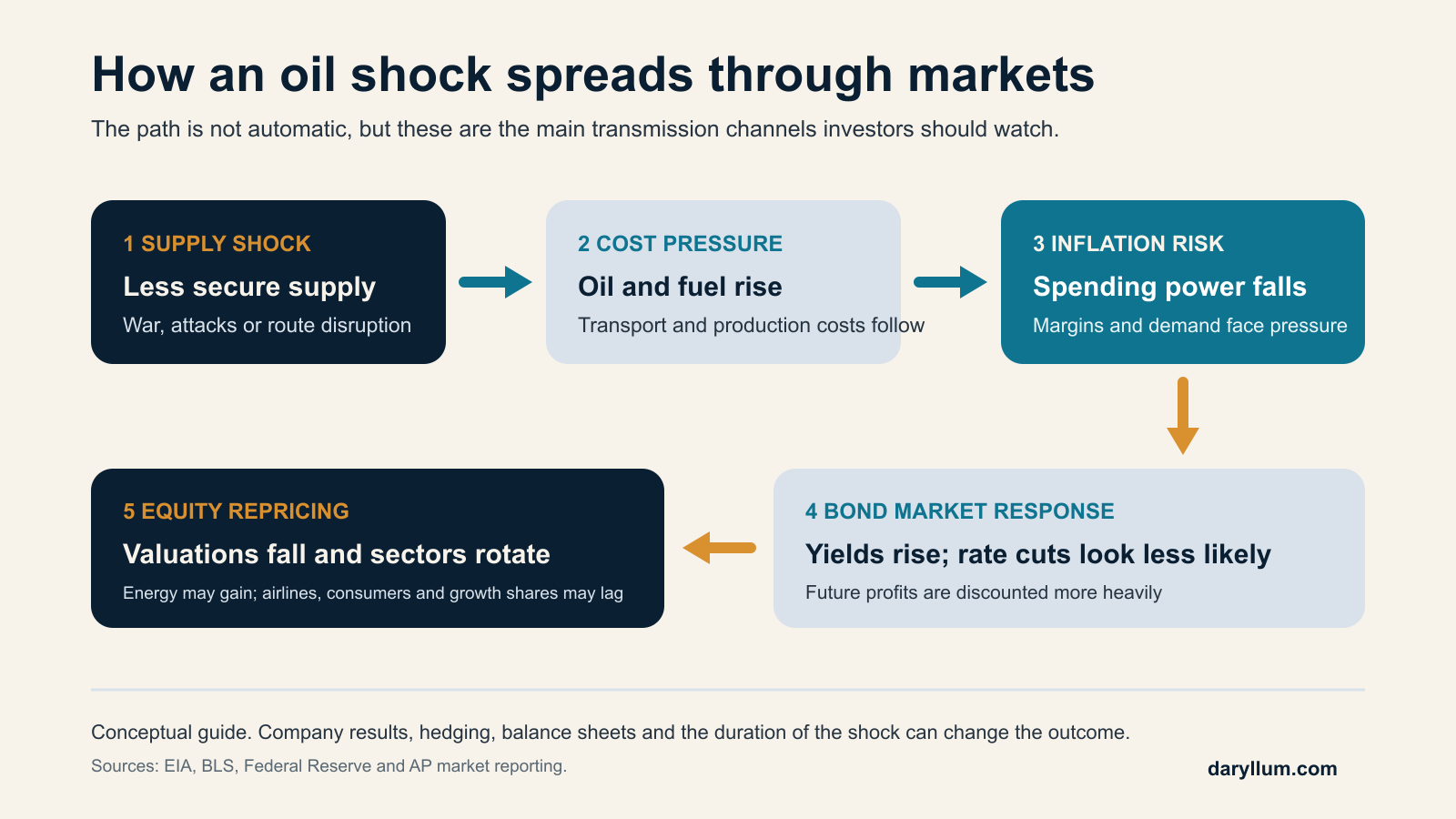
An oil shock can reach equities through inflation, interest rates, margins and consumer spending. The path depends on the duration of the shock and each company’s financial position.
Inflation and bond yields are the bridge
The bond market is the bridge between an oil shock and the valuation of a technology company.
The latest available US inflation report was already complicated. The Bureau of Labor Statistics reported that the consumer price index fell 0.4 per cent in June but was still 3.5 per cent higher than a year earlier. Energy prices fell 5.7 per cent during June, yet remained 15.7 per cent higher year-on-year. Core inflation was 2.6 per cent.
That is why investors should be careful with a single monthly figure. Energy can pull headline inflation down one month and push it up the next. If oil remains high, central banks may have less room to reduce rates. Bond investors may also demand a higher yield to compensate for inflation risk.
By 31 July, the US 10-year Treasury yield had risen to 4.71 per cent from 3.97 per cent before the war with Iran. A higher yield matters because every share is ultimately a claim on future cash flows. The further those cash flows are in the future, the more their present value falls when the discount rate rises.
This is why expensive growth shares are often described as long-duration assets. Investors may be willing to pay a high price when capital is cheap and distant profits are valued generously. They become less willing when safe bonds offer a better return and the future is discounted more heavily.
Tesla and Alphabet did not fall only because of oil
Tesla fell 14.5 per cent on 23 July. Alphabet fell 7.1 per cent. The oil shock made the market less forgiving, but both companies also gave investors reasons to reassess their own cash flows.
Tesla’s Q2 2026 filing showed strong revenue growth but much weaker operating profitability, higher research spending and negative free cash flow. Think of it as having high revenue but very thin margins. Alphabet beat revenue and profit expectations, yet investors focused on how much it planned to spend on artificial intelligence infrastructure. Its quarterly investment almost doubled from a year earlier to nearly US$45 billion.
I wrote recently that investing too heavily in artificial intelligence may be a costly mistake. The concern is not that artificial intelligence has no value. The concern is that investors may pay today for profits that are uncertain, distant and expensive to produce. I would reiterate that I believe that artificial intelligence is going to be one of, if not, the most transformative technological innovation in our lifetime. But then that does not mean that we would pay any price for a piece of a company at trying to be at the forefront of it. Imagine this, a Tesla car is a good vehicle. However, that does not mean that we should be willing to pay any price for it. There is always a fair price to pay for something. At this point in time, I believe that many stocks are overpriced. Many in the market are not paying fair prices.
The end of July also showed why we should not speak about Big Tech as though every company is the same. Amazon rose 15.3 per cent after strong profit and cloud growth suggested that its spending was producing results. Microsoft also received a positive response. Apple fell 7.4 per cent after its revenue-growth forecast disappointed.
The market was not rejecting all technology spending. It was distinguishing between spending that appeared to generate present-day profit and spending whose payoff remained harder to see.
The sector winners and losers are not automatic
Energy producers and service companies
Higher oil prices can increase revenue and cash flow for producers, especially when their production costs do not rise as quickly. Oilfield-service companies may also benefit if producers spend more. However, a temporary price spike is not the same as a durable earnings cycle. A producer with hedges, debt, political risk or high costs may not benefit as much as the headline suggests.
Airlines, shipping and logistics
These businesses consume large amounts of fuel. American Airlines fell 8.4 per cent and Southwest Airlines fell 6.2 per cent on 23 July even after reporting better-than-expected results. Yet the outcome depends on fuel hedging, ticket prices, freight rates and the strength of demand. A company that can pass on the cost is in a very different position from one that cannot.
Consumer businesses
When households spend more on transport, utilities and food, discretionary spending can weaken. Restaurants, retailers, travel companies and other consumer-facing businesses may feel the effect. The most vulnerable are usually those with weak pricing power and already-thin margins.
Growth shares and REITs
Growth shares can suffer when bond yields rise because more of their valuation depends on future profits. REITs and other income assets can also face pressure because their distributions are compared with safer bond yields, while refinancing becomes more expensive. The quality of the assets, debt maturity and rental growth still matter.
Banks
Banks may initially benefit when interest rates stay higher, but this is not a free lunch. Slower economic activity can reduce loan demand and increase credit losses. Once again, the first-order effect and the eventual effect may be different.
What this means for a Singapore investor
A Singapore investor does not need to own an oil company to be exposed to oil. The exposure may sit inside an airline, a logistics company, a REIT, a consumer business or a portfolio of US growth shares.
There is also a currency dimension. US shares are priced in US dollars, commodities are generally traded in US dollars and changes in global interest-rate expectations can move exchange rates. The return shown on a US brokerage statement may not be the same as the return in Singapore dollars.
More importantly, diversification should be based on economic drivers rather than the number of counters in a portfolio. Owning an airline, a retailer, a logistics group and a high-valued technology company may look diversified. Yet all four can be hurt by the same combination of expensive energy, weaker consumer spending and higher bond yields.
Conversely, owning several energy companies is not a complete hedge if they all depend on the same commodity price. A portfolio should be tested against the underlying risks, not merely counted by sector labels.
What I would watch next
Whether oil remains high
A brief move above US$100 is different from several months of expensive oil. Shipping routes, production volumes and the durability of the Middle East disruption matter more than one closing price.
Whether higher costs reach consumers
Petrol prices, airfares, freight rates and company guidance will show whether the shock is being passed on or absorbed through margins.
Whether bond yields stay elevated
If the 10-year Treasury yield remains high, expensive growth shares and leveraged assets may continue to face a tougher valuation environment even if oil falls.
Whether artificial intelligence spending produces cash flow
The market rewarded Amazon and Microsoft when investors could see evidence that spending was supporting growth and profit. Tesla and Alphabet received a harsher response where the cost or timing of the payoff looked less comfortable.
The conclusion is not ‘buy oil and sell technology’
Markets are not equations with one input and one output. Oil can fall while bond yields remain high. A technology company can rise despite expensive energy if its earnings are strong enough. An energy company can fall even when crude rises if its own costs, debt or operations disappoint.
The useful lesson from July is not to trade the first headline. It is to trace the shock through the cash flows. Ask who pays more, who can pass the cost on, whose customers have less money to spend and whose valuation depends most heavily on distant profits.
Once we do that, a violent market move becomes less mysterious. It may still be uncomfortable, but at least we are analysing the business rather than reacting to the noise. It just takes a little more effort to break things down to understand what is going on.
Yours sincerely,
Daryl