Artificial intelligence is probably going to change the way we live and work. I do not think that this is in dispute.
However, a revolutionary technology does not automatically make every company associated with it a good investment. More importantly, a good company does not automatically become a good investment at any price.
This is where I think many investors are getting carried away.
They hear the words artificial intelligence, robotaxi, humanoid robot, satellite internet or Grok and assume that the share price can only go higher. It is a little like buying a good condominium but refusing to ask how much the seller wants. The development may be excellent. The location may be excellent. However, if you pay far too much, your eventual return may still be poor.
I have written previously that nothing in investing travels in a singular direction. Tesla and the newly listed SpaceX are timely examples of why investors should not concentrate too heavily in one popular investment theme.
Tesla’s topline looked strong. Its operating profit did not.
Let us start with Tesla.
At first glance, Tesla’s second-quarter 2026 results looked good. Tesla’s official Q2 2026 shareholder update filed with the United States Securities and Exchange Commission showed that revenue increased by 26 per cent year-on-year to US$28.236 billion. Tesla also delivered 480,126 vehicles during the quarter, an increase of 25 per cent from a year earlier.
Those are impressive topline numbers.
However, when we move down the income statement, the picture becomes far less impressive. Operating expenses increased by 47 per cent to US$4.353 billion. Operating income fell by 57 per cent to just US$398 million. Tesla’s operating margin fell from 4.1 per cent to 1.4 per cent.
Free cash flow was negative US$1.092 billion, compared with positive US$146 million in the same quarter a year earlier. Research and development expenses increased from US$1.589 billion to US$2.371 billion.
Tesla itself said that the decline in operating income was partly caused by higher expenses from artificial intelligence and other research projects, stock-based compensation and selling, general and administrative expenses. Lower regulatory credit revenue and lower average vehicle selling prices also weighed on profitability.
So then, the problem was not that Tesla could not sell more vehicles. It did. The problem was that the additional revenue did not translate into stronger operating profit.
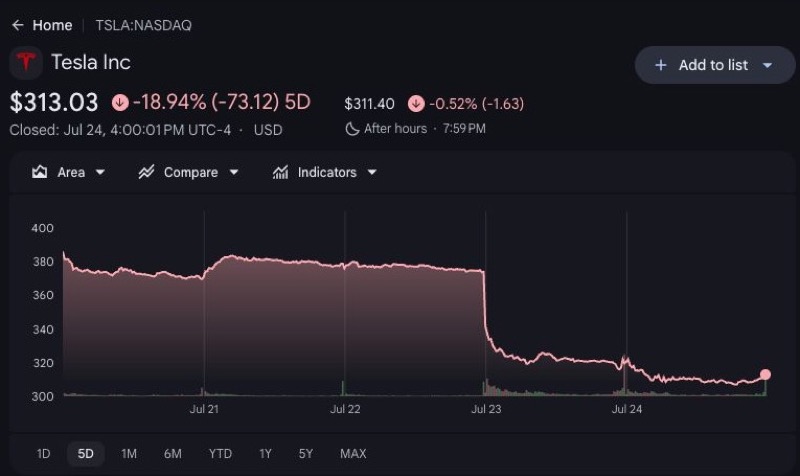
The market reacted accordingly. Tesla shares fell by about 14.5 per cent on 23 July, erasing roughly US$203 billion of market value in one trading session. The shares closed at US$313.03 on 24 July.
Does that mean Tesla is a bad company? No.
Tesla has a strong brand, a large installed base, a growing energy storage business and genuine expertise in manufacturing, software and autonomous driving. I am not dismissing these strengths. I am also not saying that Tesla’s artificial intelligence investments will never pay off.
What I am saying is that investors are paying today for many things that may only become profitable in the future. Robotaxis, Optimus humanoid robots, autonomous driving software and Tesla’s artificial intelligence infrastructure all require large amounts of capital. The eventual size and timing of the profits remain uncertain.
This was also the concern I raised in my earlier article on why Tesla’s share price was falling. The story surrounding the company had become much larger than its present-day earnings.
When a company is valued on perfection, even a good quarter can disappoint if the bottom line does not keep pace with the narrative.
SpaceX is an excellent business story. That does not settle the valuation question.
Now let us look at SpaceX.
SpaceX listed its shares in June 2026. Its official pricing announcement shows that the company sold 555,555,555 Class A shares at US$135 each. The shares began trading under the symbol SPCX and opened at US$150.
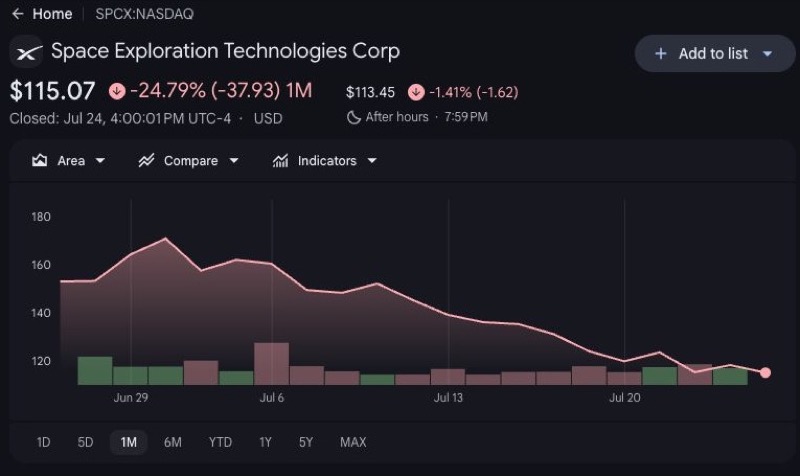
Yet the share price closed at US$115.07 on 24 July. That is about 15 per cent below the IPO price and about 23 per cent below the opening trade.
Again, this does not mean that SpaceX is a poor company. It has achieved things that many governments and aerospace companies could not. Its reusable rockets changed the economics of space launches. Starlink has also built a satellite broadband network at a scale that is difficult for competitors to replicate.
However, investors are not buying a private SpaceX that consists only of profitable rockets and Starlink. The listed group also includes the artificial intelligence and social media businesses acquired through xAI, including Grok and X.
The numbers are important.
SpaceX’s approved European prospectus shows that the group generated US$4.694 billion of revenue in the first quarter of 2026. However, it recorded an operating loss of US$1.943 billion and a net loss of US$4.276 billion.
The segment figures tell us where the strength and weakness lie.
- Connectivity, which includes Starlink, produced operating income of US$1.188 billion in the first quarter of 2026.
- The Space segment recorded an operating loss of US$662 million.
- The AI segment, which includes Grok and X, recorded an operating loss of US$2.469 billion.
In essence, Starlink is currently carrying a very large portion of the group’s economic weight.
The artificial intelligence segment generated US$818 million of quarterly revenue, up from US$727 million a year earlier. However, its operating loss widened dramatically from US$936 million to US$2.469 billion. SpaceX also spent US$7.723 billion on capital expenditure for the AI segment in the quarter alone.
There is nothing wrong with investing heavily to build a long-term business. The problem arises when investors price the future benefits as though they are already certain, while treating the present costs as though they do not matter.
Is X profitable, and is its user base leaving?
I initially thought that X might already be profitable even though some users were leaving the platform. After checking the company’s disclosures, I do not think we can state either point so confidently.
SpaceX does not provide a separately audited profit figure for X. What it does disclose is that the combined AI segment, which contains both X and Grok, is deeply loss-making.
The prospectus says that AI segment subscription revenue increased by US$177 million and data licensing revenue increased by US$12 million year-on-year in the first quarter. However, advertising revenue fell by US$100 million. This shows that subscriptions are growing, but it does not prove that X itself is profitable.
As for usage, SpaceX’s SEC-filed IPO materials state that X had approximately 550 million monthly active users and around 350 million daily posts as at March 2026. External estimates differ because social media companies do not all define or disclose usage in the same way.
Hence, I would not base an investment decision on the broad claim that everyone is leaving X. The more defensible point is that X is not the dominant global social media platform and that its combined business with Grok is consuming a great deal of capital.
Are Starlink satellites failing at a higher rate?
This is another claim that I wanted to verify. The evidence I found does not support it.
The United States Federal Communications Commission’s January 2026 order noted that SpaceX had made substantial reliability improvements between its first- and second-generation Starlink satellites. In the first reporting year, the first generation had six disposal failures, while the second generation had two.
The deployment rate is also not slowing. SpaceX’s prospectus records 96 Falcon launches in 2023, 134 in 2024 and 165 in 2025. Internal SpaceX launches, many of which deploy Starlink satellites, increased from 63 in 2023 to 89 in 2024 and 122 in 2025. Starlink had about 9,600 satellites in orbit and 10.3 million subscribers as at 31 March 2026.
Therefore, Starlink satellite reliability and deployment are not the weak points in this investment case. In fact, Starlink is arguably SpaceX’s strongest present-day business.
The real risk is concentration and the price you pay
Artificial intelligence may be one of the most important technologies of our lifetime. I use it, I see its value and I expect it to become more capable.
But I would separate four very different questions:
- Is the technology useful?
- Is the company well managed?
- Will the company eventually earn attractive profits from it?
- Is today’s share price low enough to give investors a satisfactory return?
A “yes” to the first question does not guarantee a “yes” to the other three.
This is why I would be careful about holding too much Tesla, SpaceX or any group of shares whose valuations depend on the same artificial intelligence narrative. They may look like different companies, but their share prices can fall together when investors become less willing to fund distant profits.
In property terms, owning three condominiums in the same development is not genuine diversification. In the same way, owning several high-valued artificial intelligence shares may still be one concentrated bet.
I am not asking investors to avoid artificial intelligence entirely. I am asking them to pay attention to position size, valuation, cash flow and the difference between a compelling product and a compelling share price.
What I would watch from here
For Tesla, I would watch whether operating margin recovers, whether free cash flow turns positive and whether its AI-related spending begins to produce recurring profits rather than only promises.
For SpaceX, I would watch whether Starlink can continue funding the rest of the group, whether the Space segment returns to operating profit and whether the Grok and X businesses can narrow their losses without requiring ever-larger amounts of capital.
Most importantly, I would not chase either share simply because it has fallen. A lower price is not automatically a cheap price.
Investing is not about finding the most exciting story. It is about paying a sensible price for the cash flows that the business can realistically produce.
Yours sincerely,
Daryl