The Government removed the 15-month wait-out period for private home owners buying a non-subsidised HDB resale flat. In the same week, it gave developers more time to complete and sell large residential projects arising from collective sales before the remittable portion of their Additional Buyer’s Stamp Duty, or ABSD, is clawed back.
It is tempting to read both moves as the start of a broader easing cycle for Singapore property. However, we should pause and take a step back to understand what is really going on.
In my view, both changes reduce friction. But they operate in different markets, address different problems and retain important safeguards.
So then, is Singapore loosening its property rules? Yes, in two narrow places.
Is the Government trying to restart a property boom? The evidence does not support that conclusion.
What actually changed?
Let us begin with the HDB resale market.
In other words, the Government has restored access to the open HDB resale market, while keeping the 30-month restriction for subsidised housing benefits.
The en-bloc change is different.
For collective-sale sites that will be redeveloped into 700 to 1,399 homes, developers now have six years to complete the project and sell all the units. For sites yielding at least 1,400 homes, they have seven years, although at least half the units must be sold by the end of the sixth year.
This is not an ABSD rate cut. In my view, it recognises that a very large project carries different execution and sales risks from a much smaller development. Selling all or even most of the units in a very large project is naturally more difficult.
The Singapore government is calibrating. Not stimulating.
So why make these changes now?
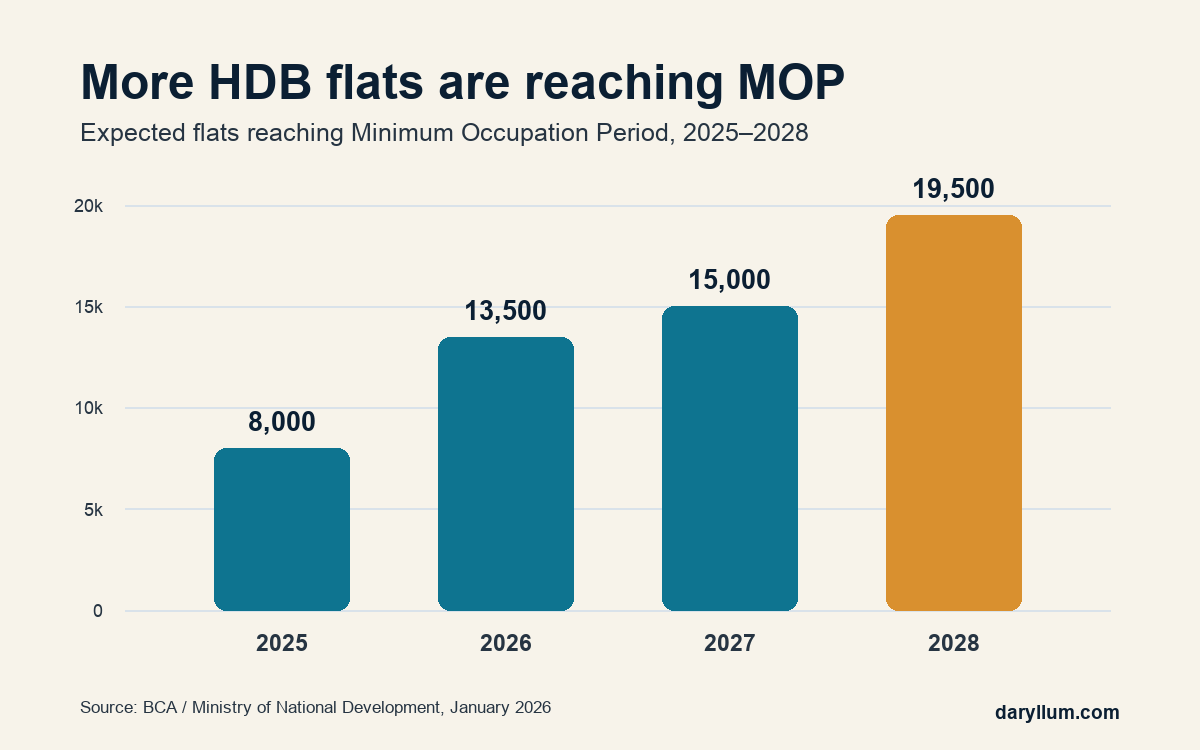
HDB resale prices fell by 0.1 per cent in the first quarter of 2026 and another 0.3 per cent in the second. At the same time, more flats are expected to reach their Minimum Occupation Period over the next few years and become eligible for resale.
That gives the Government room to remove a temporary restriction introduced in September 2022, after construction delays, a low-interest-rate environment and higher housing demand contributed to an imbalance in the HDB resale market.
The two quarterly declines amount to a cumulative fall of 0.4 per cent. That does not suddenly make resale flats cheap. What has changed is the direction and pace of the market, together with the supply outlook.
The supply figures are important. About 13,500 flats are expected to reach their Minimum Occupation Period in 2026, up from around 8,000 in 2025. The number is expected to rise further to 15,000 in 2027 and 19,500 in 2028.
At the same time, HDB plans to launch about 55,000 BTO flats between 2025 and 2027. More resale choices are therefore coming onto the market, while a strong BTO pipeline gives eligible buyers an alternative to paying ever-higher resale prices.
The Government says the en-bloc revision is meant to support large-scale redevelopment, rejuvenate sites and make additional housing supply available. In my view, the earlier framework did not sufficiently account for the longer construction programme, larger capital commitment and sales risk that come with a very large site.
If the rules discourage developers from bidding for those sites at all, the policy defeats the urban-renewal objective it was meant to support.
That is why I see both announcements as policy maintenance. One temporary restriction had served its purpose. One developer deadline was insufficiently proportionate to project size.
Neither conclusion requires us to believe that the whole property market needs rescuing.
The original rule was designed to shield HDB from excess liquidity
When the 15-month wait-out period was introduced in September 2022 as a temporary measure to moderate demand for resale flats, it served a clear purpose.
When the measure was introduced, construction delays, higher housing demand and a low-interest-rate environment had contributed to an imbalance in the HDB resale market. In my view, private property sellers with substantial sale proceeds represented additional purchasing power that risked pushing prices even higher.
The Government’s stated purpose for the wait-out period was to moderate demand for resale flats. My reading is that it also shielded the HDB resale market from excess liquidity at a particularly unsettled moment.
That context has now changed.
The resale price index fell in the first two quarters of 2026, while the MOP pipeline is expanding and HDB plans about 55,000 BTO flats between 2025 and 2027. In my view, this makes the removal timely. A rule that was useful during a period of excess demand need not remain indefinitely after the balance of the market has shifted.
In my view, removing it allows this group of buyers to return and provide a measure of support to the resale market as it cools.
The effect, however, will not be evenly distributed.
I expect a private home owner who is right-sizing to enter the HDB market with different priorities from a typical first-time buyer. After selling a private property, this buyer may place a higher value on space, location, lease balance and the ability to move in quickly. That could direct more purchasing power towards five-room flats, executive flats and higher-quantum units in mature or well-connected estates.
Does that mean the overall HDB resale index will surge? Not necessarily.
The returning buyer pool is only one part of a large market. More resale supply is coming as the number of flats reaching MOP rises. The 30-month restriction on subsidised purchases remains. The Government has also cautioned that the global economic outlook remains uncertain, which can make households more cautious.
But averages may conceal what happens at the top end. The overall resale index can remain stable while selected flats attract more offers and set new price records.
This is the part of the policy change I would watch most closely. Not whether every HDB flat rises, but whether the premium for scarce, large and well-located flats widens.
There may also be a secondary effect on rentals. Households without alternative accommodation may previously have needed to rent during the 15-month gap. Allowing them to move directly into a resale flat could remove some of that temporary rental demand.
Removing the wait-out period is reasonable, but not costless
My view is that the wait-out rule had become too blunt.
The Government acknowledged that the wait-out period caused inconvenience and disruption to some private home owners with genuine housing needs. A family could be trying to reduce its mortgage, free up retirement funds, move closer to children or shift from a condominium to a larger HDB flat that better suits its needs. In such cases, forcing the family to rent for 15 months imposed a real cost without creating a new home.
Removing the rule restores mobility across the housing ladder. It may also bring more private resale homes onto the market when right-sizers dispose of their existing properties.
However, restoring mobility and preserving HDB affordability are not automatically the same thing.
My concern is that private property owners are returning to a public housing resale market where affordability remains sensitive. Although these buyers cannot immediately access grants or an HDB housing loan, additional purchasing power can still affect the price paid for a resale flat.
The safeguard is therefore not the absence of an impact. The safeguard is that the impact should be limited by supply and concentrated in a narrower segment.
If premium-flat prices accelerate sharply while the broader index stays calm, policymakers should not hide behind the island-wide average. They should examine the segment that the rule was originally designed to influence.
That would not mean the removal was a mistake. It would mean a targeted policy deserves targeted monitoring.
Longer en-bloc timelines help, but price still decides the deal
My reading of the en-bloc change is similarly measured.
The Government said the longer timelines are intended to support large-scale redevelopment, rejuvenate sites and make additional housing supply available. In my view, a developer should not be forced to launch 1,500 units too aggressively merely because the tax clock is running. Giving such projects more time is logical.
But the revision does not fundamentally change project economics.
Developers remain subject to a 40 per cent ABSD, including a 5 per cent non-remittable component, and must meet commencement, completion and sales conditions to retain remission of the remaining 35 per cent. In assessing the project economics, I would still account for the land purchase, construction costs and the uncertainty of the future sales market.
Above all, the reserve price still has to make sense.
The extra time has value. The danger is that owners treat that value as a reason to raise—or refuse to reduce—their asking price. If every dollar of risk relief is capitalised into the land price, the developer is no better off and the sale still does not happen.
The longer deadline can reopen the conversation, but realistic pricing will determine whether a deal closes.
The policy is necessary for some mega sites. It is not sufficient.
Buyers should not assume the concession will make new homes cheaper
There is another leap in logic worth avoiding.
If developers face less ABSD timing risk, will the eventual homes be cheaper?
Not automatically.
In my view, part of the benefit may be passed back to the existing owners through a higher land bid. I would still expect developers to account for construction and financing costs, competing projects and what buyers are willing to pay when pricing the new units.
The public benefit is more indirect. The Government says the framework is intended to facilitate site rejuvenation and make additional housing supply available. Over time, a more diverse land supply can also reduce dependence on Government Land Sales sites alone.
That is worthwhile. It is simply not the same as promising lower launch prices.
My view
I do not read these changes as a U-turn on cooling measures.
The HDB announcement removed one temporary eligibility restriction, while the en-bloc announcement adjusted one developer ABSD timeline. In my view, these targeted changes do not amount to a general relaxation of Singapore’s cooling, credit and housing-supply framework.
For the HDB market, the benefit is greater flexibility and a broader pool of demand at a time when substantially more flats are becoming eligible for resale. The risk, in my view, is renewed price pressure in larger and premium resale flats.
For the en-bloc market, the benefit is lower execution risk. The obstacle remains the gap between what owners hope to receive and what developers can prudently pay.
In my view, there is no benefit to Singapore in engineering a steep correction in home prices. A disorderly fall would damage confidence, household balance sheets and the broader economy. The more sensible objective is a market that cools without collapsing.
To those who have property agents telling them to hurry buy HDB properties as prices will rise due to an increase in buyers should then ask the same property agents whether by the same logic, the rule takes away buyers from the private property market and hence private property prices should fall.
I cannot know whether this was the Government’s explicit intention. But against the rising housing-supply pipeline and the Government’s warning of an uncertain global outlook, I read the removal of the wait-out period as consistent with a softer-landing approach: allow enough demand to support an easing market, while keeping the main cooling, credit and supply controls in place.
Both changes are defensible. Neither is a reason for buyers, sellers or en-bloc owners to become less realistic.
The rules may have changed. The price still has to make sense.
Yours sincerely,
Daryl Lum